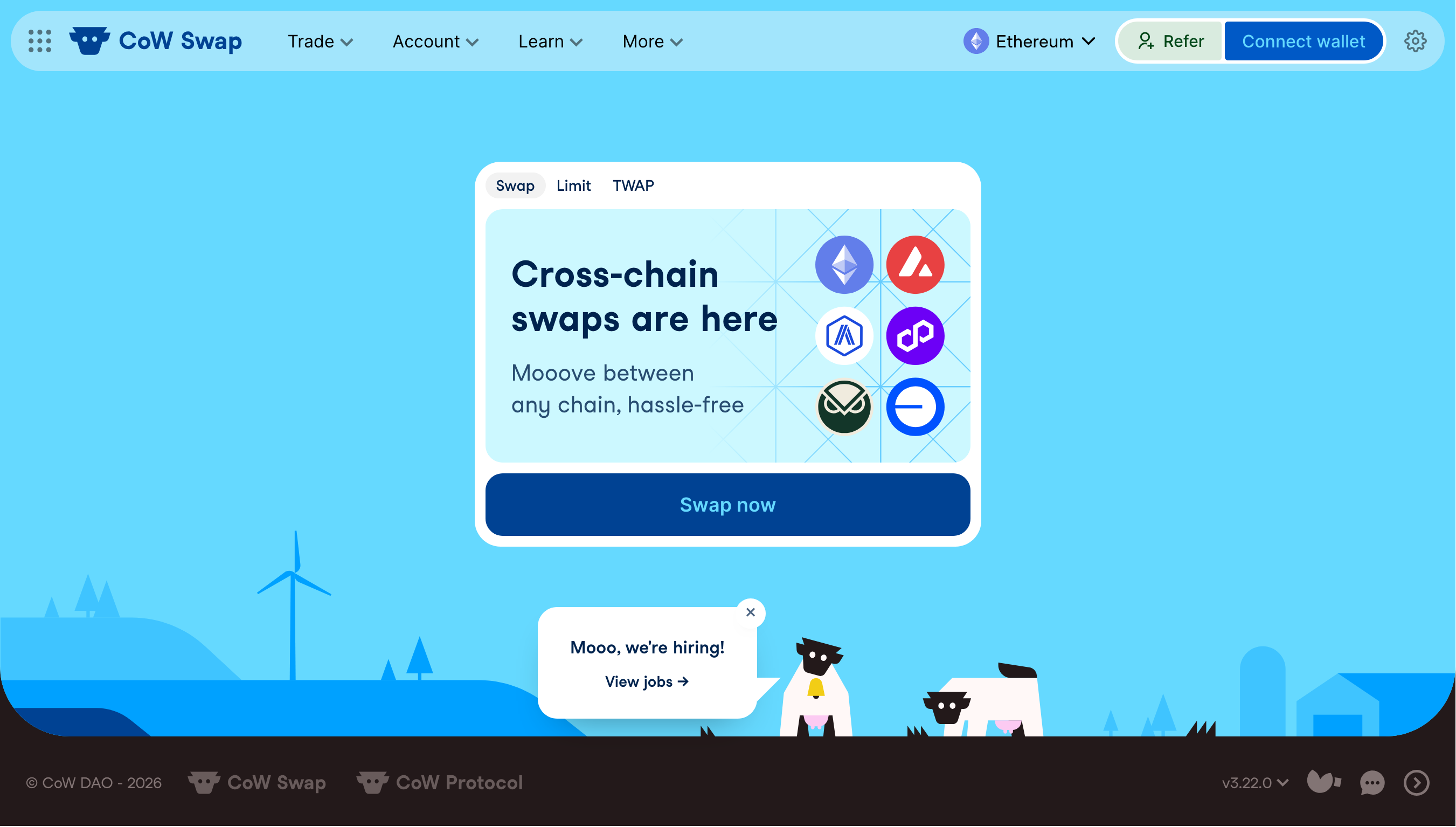
Decentralized exchanges (DEXs) have transformed the way people trade cryptocurrencies by enabling peer-to-peer transactions without intermediaries. However, many DEX users face challenges such as high slippage, poor pricing, and Miner/Maximal Extractable Value (MEV), which can increase trading costs and reduce returns.
CoW Swap is a decentralized trading platform designed to address these issues. By using a unique batch auction mechanism and matching compatible trades directly between users, CoW Swap helps traders achieve better prices while reducing exposure to MEV attacks.
Whether you're a DeFi enthusiast, investor, or trader, understanding how CoW Swap works can help you execute more efficient and secure token swaps.
What Is CoW Swap?
CoW Swap is a decentralized exchange (DEX) and trade-intent protocol that aggregates liquidity from multiple decentralized exchanges while using Coincidence of Wants (CoW) to match compatible buy and sell orders directly between users.
Instead of executing every trade against a traditional liquidity pool, CoW Swap batches multiple user orders together. When two users have matching trading intentions, their orders can be settled directly without interacting with external liquidity sources. If direct matching isn't possible, the protocol sources liquidity from multiple decentralized exchanges to secure competitive pricing.
This approach helps reduce slippage, lowers trading costs, and offers protection against certain forms of MEV.
How CoW Swap Works
CoW Swap operates differently from most decentralized exchanges.
The general process includes:
Users submit trade intents instead of immediately executing swaps.
Orders are grouped into batch auctions.
Specialized "solvers" compete to find the most efficient way to settle all orders.
Whenever possible, compatible orders are matched directly using Coincidence of Wants.
If direct matching is unavailable, the protocol accesses liquidity from multiple decentralized exchanges.
The best settlement is executed on-chain.
This auction-based system seeks to maximize execution quality while minimizing unnecessary costs.
Key Features of CoW Swap
1. MEV Protection
One of CoW Swap's standout features is protection against certain MEV-related strategies, including front-running and sandwich attacks.
Because trades are executed through batch auctions rather than immediately upon submission, opportunities for malicious transaction ordering are significantly reduced.
2. Batch Auctions
Unlike traditional decentralized exchanges that process transactions individually, CoW Swap batches multiple orders together.
Benefits include:
Better overall pricing
Reduced slippage
Increased trading efficiency
Fairer order execution
3. Coincidence of Wants (CoW)
The protocol attempts to directly match users whose trading intentions complement each other.
For example:
User A wants to swap ETH for USDC.
User B wants to swap USDC for ETH.
Rather than routing both trades through liquidity pools, CoW Swap can settle them directly, reducing trading costs.
4. Liquidity Aggregation
When direct matching isn't possible, CoW Swap aggregates liquidity from multiple decentralized exchanges to identify competitive execution paths.
This gives users access to a broad range of liquidity without manually comparing exchanges.
5. Low Slippage
By combining direct order matching with liquidity aggregation, CoW Swap often reduces slippage compared to conventional decentralized exchanges.
This can be particularly valuable for larger trades.
6. Gas Efficiency
Since multiple trades can be settled together in a single batch, users may benefit from improved gas efficiency depending on network conditions and trade execution.
Benefits of Using CoW Swap
CoW Swap offers several advantages:
Protection against certain MEV attacks
Competitive token pricing
Lower slippage
Access to aggregated liquidity
Transparent on-chain settlement
Efficient batch execution
User-friendly trading interface
These features make it an attractive option for both retail and professional DeFi participants.
Common Use Cases
Traders use CoW Swap for various purposes, including:
Swapping ERC-20 tokens
Executing large trades with reduced slippage
Seeking MEV-resistant execution
Accessing liquidity across multiple DEXs
Optimizing decentralized trading costs
Participating in decentralized finance (DeFi)
Is CoW Swap Safe?
CoW Swap is a non-custodial decentralized protocol, meaning users retain control of their assets until a trade is executed. The platform does not take custody of users' funds during normal trading.
As with any DeFi application, users should:
Verify they are using the official CoW Swap interface.
Review transaction details before signing.
Understand the risks associated with smart contracts and decentralized trading.
Keep wallet recovery phrases and private keys secure.
Limitations of CoW Swap
Although CoW Swap provides several advantages, it also has some limitations:
Execution may take longer than instant DEX swaps because orders are processed in batches.
Direct order matching is not always possible.
Trading outcomes depend on available liquidity and market conditions.
Users still pay blockchain network fees for completed transactions.
Smart contract risks are inherent in decentralized finance protocols.
Why CoW Swap Matters
MEV has become one of the most significant challenges in decentralized trading. Traditional decentralized exchanges often expose users to front-running, sandwich attacks, and unnecessary slippage.
CoW Swap addresses these issues through batch auctions, solver competition, and direct order matching. By prioritizing execution quality rather than speed alone, it offers a more efficient trading experience for many users.
Its innovative design demonstrates how decentralized protocols can improve fairness, transparency, and efficiency in on-chain trading.
Conclusion
CoW Swap is one of the most innovative decentralized exchanges in the Ethereum ecosystem. Through Coincidence of Wants matching, batch auctions, and liquidity aggregation, it helps users achieve competitive prices while reducing exposure to certain forms of MEV.
Whether you're making occasional token swaps or managing larger DeFi transactions, CoW Swap provides an efficient, transparent, and user-focused approach to decentralized trading. As decentralized finance continues to evolve, protocols like CoW Swap are likely to play an increasingly important role in improving the trading experience across blockchain networks.

Mobirise.com